Every time you send an email, load a website, or stream a video, millions of data packets travel across global networks. But how do these packets know where to go without getting lost, corrupted, or delivered to the wrong machine?
The answer lies in network protocols—the universal rules that govern how data moves across the internet.
What Are Network Protocols?
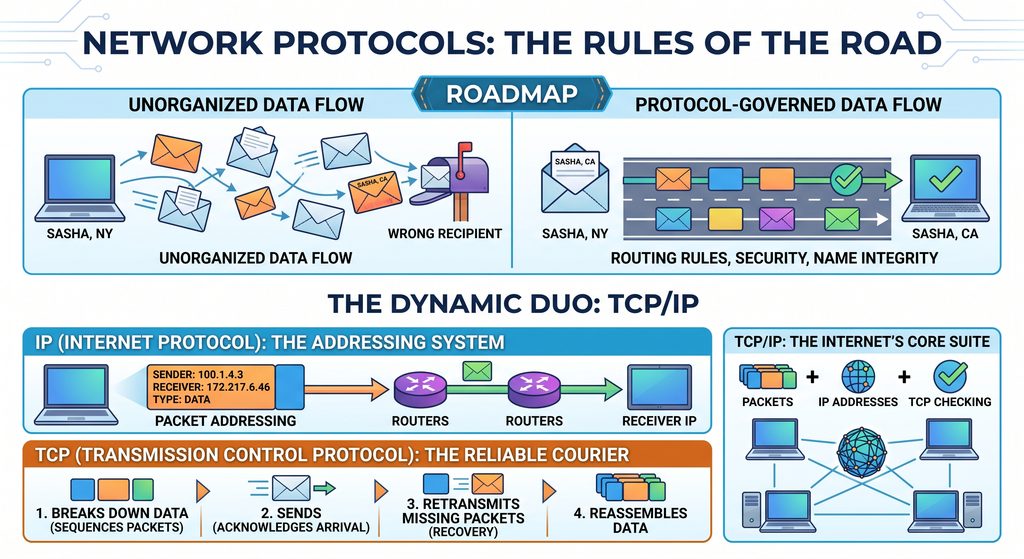
Think of network protocols like the postal system’s standard operating procedures.
If you mail a letter to a friend named Sasha in California, postal rules ensure it doesn’t accidentally end up with another Sasha in New York. The postal service checks the zip code, street address, and recipient name to ensure accurate delivery.
Networking protocols do the exact same thing for digital data. They establish strict rules to ensure data packets are:
- Routed efficiently along the fastest available path.
- Delivered accurately to the specific intended device.
- Protected from corruption and kept secure during transit.
- Formatted and named so the receiving device can interpret them.
The Dynamic Duo: TCP/IP
While hundreds of specialized protocols exist across the networking stack, the internet primarily runs on a core suite known as TCP/IP (Transmission Control Protocol / Internet Protocol).
- IP (Internet Protocol) – The Addressing System:IP is responsible for addressing and routing packets. Just as a physical house has a street address, every connected device receives an IP address (such as
172.217.6.46). IP ensures that packets are stamped with sender and receiver addresses so network routers can direct them to the right destination. - TCP (Transmission Control Protocol) – The Reliable Courier:While IP handles addressing, TCP ensures reliable delivery. It breaks data down into manageable packets on the sending side, numbers them, and verifies that every single packet arrives intact. If a packet is dropped or corrupted in transit, TCP requests a retransmission before reassembling the data in the correct order.
Together, TCP and IP form the backbone of modern digital communication, ensuring data travels across billions of interconnected devices seamlessly and reliably.