Not long ago, our daily lives were strictly defined by physical geography.
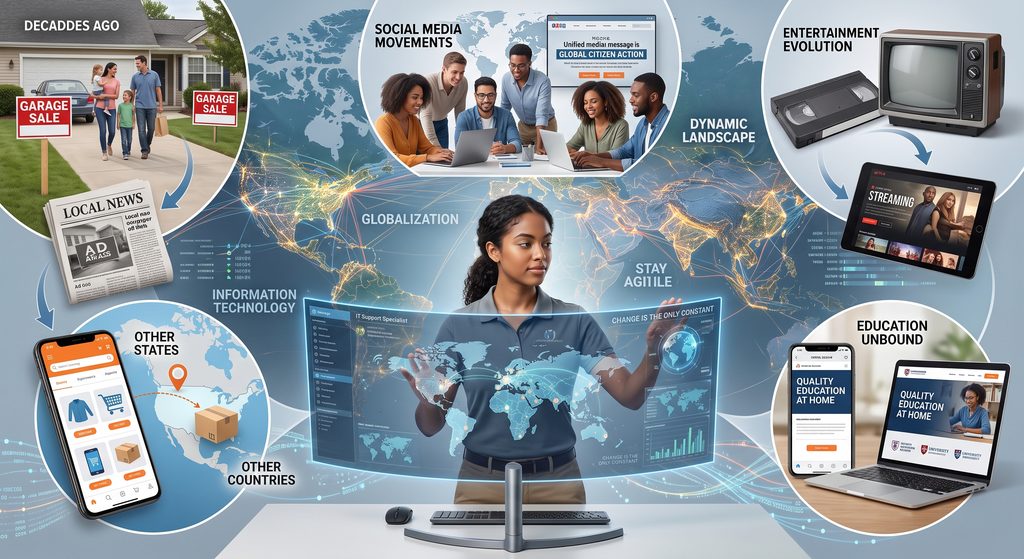
If you wanted to sell a used bicycle decades ago, you hauled it to the end of your driveway, handmade a cardboard garage sale sign, and hoped a neighbor drove by. To scale up, you bought a paid classified ad in the Sunday paper.
Today, that same sale happens in seconds across digital marketplaces, connecting buyers and sellers across cities, states, and oceans. The internet did not just make it easier to text family; it dismantled physical borders and accelerated global connectivity on a massive scale.
1. The Supercharged Engine of Globalization
Information technology transformed globalization from a slow economic theory into an instantaneous reality:
- Real-Time Trade & Communication: Governments and global enterprises exchange critical data, finalize contracts, and navigate financial markets in fractions of a second.
- Unified Social Movements: Digital connectivity allows local events to spark international momentum. During historic movements like the 2011 Arab Spring, social media bypassed traditional media barriers, uniting citizens worldwide under shared causes.
- Instant Information: News on the other side of the planet reaches our feeds long before a traditional morning edition could even head to print.
2. Entertainment on Demand
The transition from physical media to continuous streaming completely reshaped consumer expectations:
| Era | Media Format | Access Model |
| Broadcast & Physical | Vinyl, cassette tapes, CDs, scheduled linear TV | Appointment viewing; buying entire albums for one track |
| Bridging Tech | VHS tapes, TiVo, DVR recording | Time-shifted viewing with physical/hardware limits |
| Modern Streaming | Cloud streaming (audio & video on demand) | Instant, unlimited access to global libraries on any device |
3. Commerce and Classrooms Without Borders
The modern web moved everyday utilities entirely into the cloud:
- Frictionless E-Commerce: From groceries and fashion to specialized equipment, retail shifted from brick-and-mortar storefronts to global on-demand delivery networks.
- Decentralized Education: Top universities and independent learning platforms dismantled the four-wall classroom. Accessible degrees, technical certifications, and skill-based learning tools are available to anyone with an internet connection.
The Takeaway for IT Professionals
All of this global commerce, continuous streaming, virtual classrooms, and the shift from desktop computing to mobile-first ecosystems rests on digital infrastructure.
In technology, change is the only constant. For IT support specialists and tech professionals, staying agile, continuously upskilling, and understanding the systems powering this hyper-connected world is essential to keeping everything running.