From banking and education to instant entertainment, the modern internet powers nearly every facet of our daily routines. Yet, the global network we rely on today is the culmination of decades of engineering breakthroughs, created to solve very real physical and technological bottlenecks.
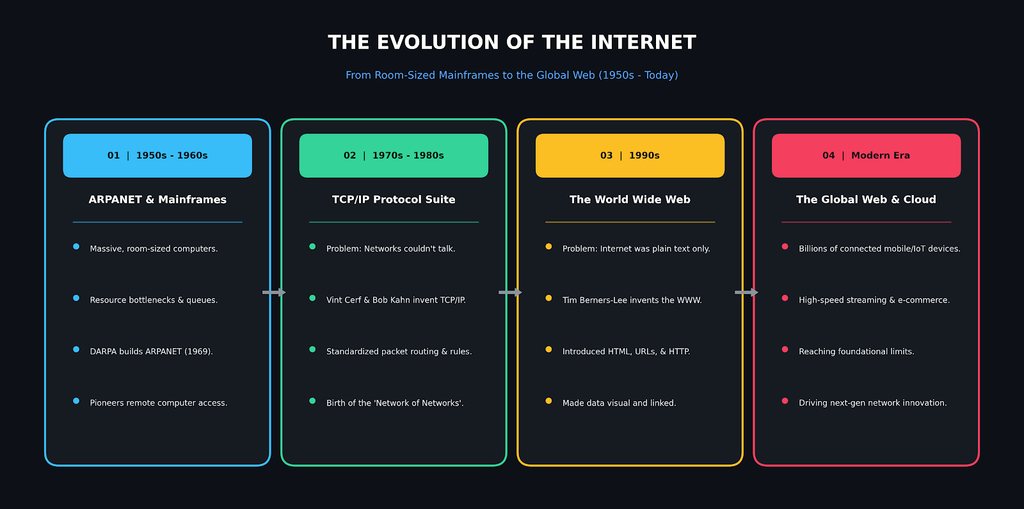
1. The 1950s–1960s: Room-Sized Computers and ARPANET
In the 1950s, computers were massive, expensive, room-sized machines. Programmers had to interact with them directly on-site, creating massive bottlenecks when multiple people needed to use the same limited computing resources.
To solve this resource-sharing challenge, the U.S. government launched a project through DARPA in the late 1960s, creating ARPANET. This early foundation enabled researchers and programmers to access a centralized computer remotely.
2. The 1970s: Unifying Networks with TCP/IP
While ARPANET proved remote access was possible, a major hurdle remained: different independent networks could not communicate with each other.
In the 1970s, computer scientists Vinton Cerf and Bob Kahn solved this by developing TCP/IP (Transmission Control Protocol / Internet Protocol). TCP/IP created a standardized set of rules that allowed distinct networks to bridge together. What began with adoption across a handful of universities, government institutions, and businesses quickly scaled into the foundation connecting billions of devices worldwide.
3. The 1990s: Tim Berners-Lee and the World Wide Web
Even with TCP/IP in place, early internet communication was limited to decentralized, plain text.
In the 1990s, Tim Berners-Lee revolutionized the ecosystem by inventing the World Wide Web (WWW). By introducing standard protocols for linking and displaying multimedia web pages, the web made information visual, navigable, and universally accessible to anyone with an internet connection.
4. The Modern Internet and Beyond
In just a few decades, digital communication has transformed:
- From plain text messages to high-definition video conferencing.
- From static documents to instant e-commerce, digital banking, and global online learning platforms.
Understanding this evolution is essential for modern IT professionals: as the internet continues to expand, many of its foundational designs are reaching their architectural limits, setting the stage for the next wave of networking innovation.