Modern developers write code using words that closely mirror human language, but computers still only understand one thing: electricity flowing through billions of tiny switches as 1s and 0s.
Closing the gap between human thought and raw silicon took decades of innovation. Here is how programming evolved from stacks of punched cardboard into modern high-level languages and automation scripts.
1. The 1950s: Punch Cards and Pure Binary
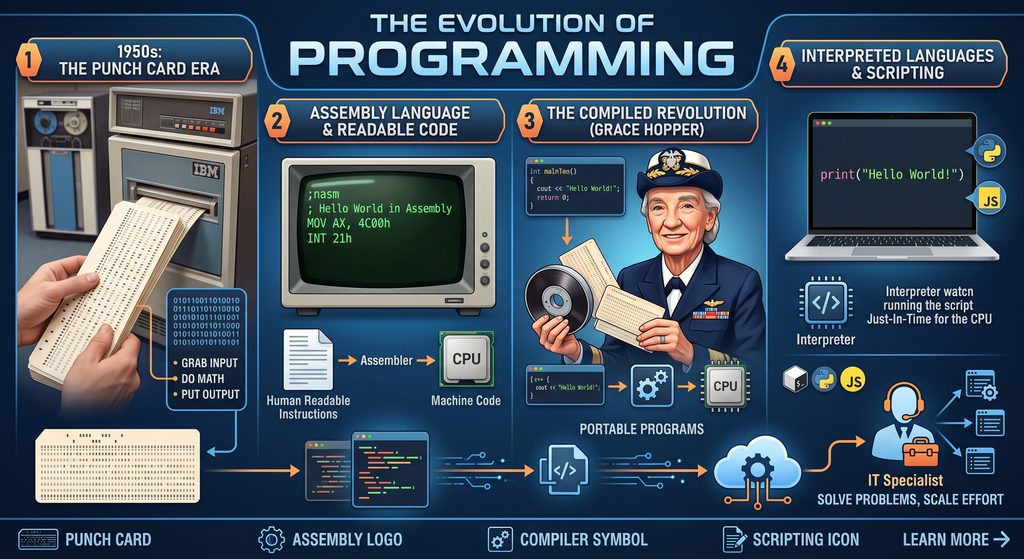
In the early days of computing, programming was a physical, mechanical process. Programs were encoded on punch cards stiff paper cards where holes represented binary bits (1s) and solid spaces represented zeros (0s).
Physical Punch Card ──> Card Reader ──> CPU Reads Raw Binary (01001010...)
A program required the CPU to perform micro-steps:
- Fetch raw data from a specific memory address.
- Perform a low-level arithmetic operation.
- Write the result back to another exact memory register.
Writing software this way was painstaking. A single typo meant repunching an entire card, and a complex program required thousands of cards neatly organized in physical stacks. If a stack dropped on the floor, the entire system broke.
2. Assembly: The First Step Toward Readability
To eliminate raw binary entry, engineers created assembly language. Assembly substituted cryptic binary strings with mnemonic codes that humans could parse:
- Binary:
10110000 01100001 - Assembly:
MOV AL, 61h(Load value into register AL)
Instead of tracking every individual bit, programmers could write structured operations like:
MOV R1, [Memory_A]   ; Load value from Memory A into Register 1
MOV R2, [Memory_B]   ; Load value from Memory B into Register 2
ADD R4, R1, R2       ; Add R1 and R2, store result in Register 4
While assembly was a massive improvement, it remained hardware-dependent. Code written for one CPU architecture could not run on another. Developers still had to think like hardware engineers rather than software designers.
3. Compilers and Portability: The Grace Hopper Revolution
The modern era began when Rear Admiral Grace Hopper developed the first compiler.
A compiler acts as a universal translator: it accepts human-readable instructions written in high-level code and translates the entire codebase into machine-executable binary ahead of time.
Source Code (C, Rust, Go) ──[ Compiler ]──> Executable Binary (.exe / ELF) ──> CPU Execution
Key Advantages of Compiled Languages:
- Hardware Portability: Write the logic once; compile it with different target compilers to run across diverse CPU architectures (x86, ARM, etc.).
- Expressive Syntax: Programmers write natural logic (e.g.,
total = price + tax;) instead of manual register allocations. - Execution Speed: Because translation happens ahead of time, compiled binaries run directly on the CPU at peak performance.
4. Interpreted Languages: Instant Execution and Scripting
As computing power grew, developer productivity became more valuable than raw execution speed for many day-to-day tasks. This led to interpreted languages (such as Python, JavaScript, and Bash).
Unlike compiled code, interpreted languages do not generate a standalone binary beforehand. Instead, an interpreter parses and executes instructions on the fly, line by line.
| Feature | Compiled Languages (C, C++, Go) | Interpreted Languages (Python, Bash, JS) |
| Translation Time | Ahead of time (build phase) | Just-in-time / line-by-line during runtime |
| Output | Standalone binary machine code | Interpreted script |
| Portability | Requires recompilation per CPU target | Runs anywhere the interpreter is installed |
| Primary Use Case | Systems programming, game engines, OS kernels | Automation, system administration, web, rapid prototyping |
Why Scripting Matters Today
For IT specialists, DevOps engineers, and system administrators, scripting provides leverage:
- Automation: Turn repetitive manual tasks such as user onboarding, backup verification, and log rotation into repeatable workflows.
- Rapid Problem Solving: Write a script once to diagnose or fix an issue across thousands of endpoints simultaneously.
- Operational Agility: Modify logic on the fly without waiting through lengthy compilation and deployment cycles.
Every modern high-level language and automation tool exists because engineers continuously abstracted the hardware underneath. Understanding this progression allows you to pick the right tool for the job whether you need the raw speed of compiled binaries or the fast adaptability of an automation script.