Whether dealing with an upset restaurant diner or a user locked out of a critical production server, high-tension customer service situations trigger the exact same biological response. Understanding the physiological science behind stress is the first step toward staying composed and de-escalating difficult technical interactions.
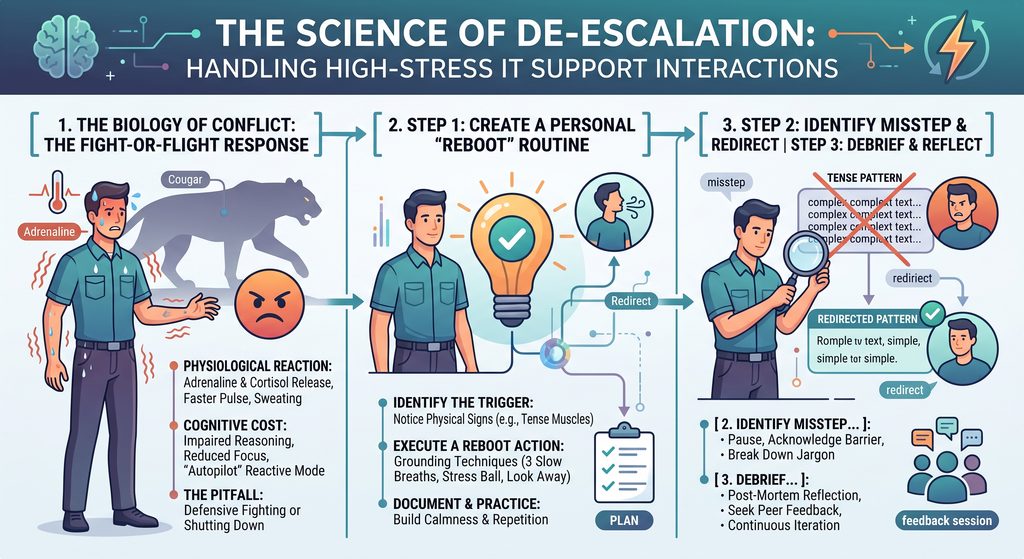
The Biology of Conflict: The Fight-or-Flight Response
When a user raises their voice, sends an angry message in ALL CAPS, or demands an immediate fix, your body perceives a threat.
- Physiological Reaction: Your brain releases hormones like adrenaline and cortisol. Your pulse accelerates, palms sweat, muscles tense, and tunnel vision sets in.
- The Cognitive Cost: This primal survival mechanism is designed for physical danger, not analytical troubleshooting. It impairs higher-order reasoning, degrades focus, and pushes you into reactive “autopilot.”
- The Pitfall: Reacting on autopilot often triggers a defensive fight-or-flight response (such as arguing back or shutting down), which invariably escalates the conflict.
Step 1: Create a Personal “Reboot” Routine
Because your rational brain is compromised under acute stress, you need a pre-planned, tangible action to bring your physiology back to a calm baseline.
- Identify the Trigger: Notice your early physical signs a tightening chest, rapid breathing, or an increased heart rate.
- Execute a Reboot Action: Choose a simple grounding action to interrupt the biological spike:
- Taking three slow, deep diaphragmatic breaths.
- Looking away from the screen for five seconds.
- Squeezing a stress ball or relaxing your shoulders.
- Document and Practice: Write your reboot action down. Rebuilding calmness in high-pressure moments takes repetition before it becomes second nature.
Step 2: Identify the Misstep and Redirect
Once you restore emotional composure, shift from reacting emotionally to diagnosing why the interaction derailed.
Consider this common escalation pattern:
- The technician asks a technical question (e.g., “What error code appears when the background sync fails?”).
- The user does not understand the technical terminology.
- Instead of explaining, the technician repeats the exact same question.
- The user feels unheard, assumes the technician isn’t paying attention, and escalates to anger.
The Fix: When an interaction turns tense, pause and reframe:
- Acknowledge the Barrier: “Let me rephrase that I want to make sure I’m asking the right question.”
- Break Down Technical Terms: Swap complex jargon for plain, observable behavior (e.g., “What is the exact sentence shown in the pop-up box?”).
Step 3: Debrief, Reflect, and Seek Peer Feedback
De-escalation is a practiced craft that improves with intentional reflection.
- Perform a Post-Mortem: After a difficult call or chat, reflect on where the tone shifted and how you responded.
- Involve Colleagues: Share difficult scenarios with peers or team leads to ask for objective feedback on how they would have reframed the conversation.
- Iterate Continuously: Treating tense interactions as learning opportunities builds long-term emotional resilience and professional credibility.