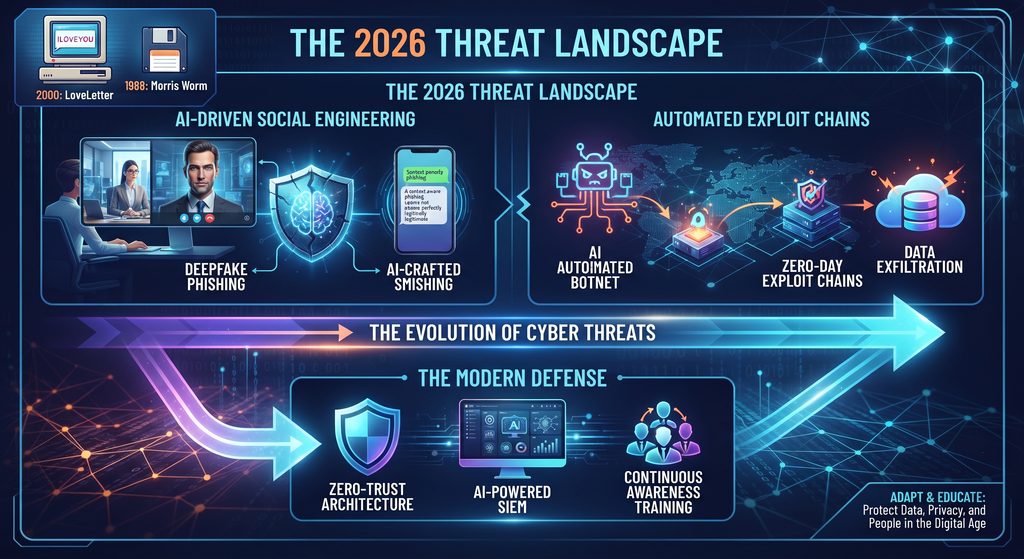
The evolution of cyber threats has shifted dramatically from the historical worm and virus outbreaks of the late 20th century into an era dominated by hyper-automation, artificial intelligence, and sophisticated social engineering. While classic breaches like the LoveLetter worm and Equifax taught the industry foundational lessons about vulnerabilities and patch management, modern attackers in 2026 are leveraging advanced technologies to execute stealthier and far more damaging campaigns.
1. AI-Driven Social Engineering and Deepfakes
- The Shift: Unlike the static “I Love You” email attachments of 2000, today’s social engineering uses generative AI and deepfake technology. Threat actors routinely clone voices, manufacture hyper-realistic video feeds, and deploy context-aware phishing emails tailored to specific corporate targets.
- The Impact: Traditional indicators of a scam like poor grammar or clumsy phrasing are virtually gone. Attackers easily bypass human skepticism by impersonating C-level executives or trusted vendors in real-time video calls and voice notes.
- The Defense: Organizations must move beyond basic annual training to implement continuous, AI-resilient simulation drills, strict multi-factor authentication (MFA) protocols, and out-of-band verification policies for financial transactions.
2. Automated Exploit Chains and Zero-Day Exploits
- The Shift: Where past breaches like Equifax relied on unpatched systems sitting stagnant for months, modern threat actors use automated scanning bots powered by machine learning to find and exploit zero-day vulnerabilities within minutes of discovery.
- The Impact: The window between a vulnerability being discovered and it being actively weaponized has shrunk to nearly zero. Supply chain compromises (targeting third-party software vendors) have become the go-to method to bypass perimeter defenses.
- The Defense: Security teams rely heavily on automated Security Information and Event Management (SIEM) tools, continuous vulnerability management, and zero-trust architecture to isolate systems the moment anomalous behavior occurs.
Why History Still Matters in 2026
Even with the rise of autonomous malware and AI-driven cyber warfare, the fundamental principles of defense remain unchanged. Understanding how early attacks exposed human error and structural negligence gives modern security analysts the context needed to design resilient architectures.
As a security professional today, adapting to the 2026 threat landscape means combining automated defense systems with vigilant risk management to protect organizational data, privacy, and people.